- DSpace Home
- →
- 1. Research Paper
- →
- Journal Articles
- →
- View Item
JavaScript is disabled for your browser. Some features of this site may not work without it.
| dc.contributor.author | Firdaus Muhammad-Sukki | |
| dc.contributor.author | Abu Bakar Munir | |
| dc.contributor.author | Siti Hajar Mohd Yasin | |
| dc.contributor.author | Roberto Ramirez-Iniguez | |
| dc.contributor.author | Scott G McMeekin | |
| dc.contributor.author | Brian G Stewart | |
| dc.contributor.author | Ruzairi Abdul Rahim | |
| dc.contributor.author | Siti Hawa Abu-Bakar | |
| dc.contributor.author | (UniKL BMI) | |
| dc.date.accessioned | 2014-10-27T04:57:30Z | |
| dc.date.available | 2014-10-27T04:57:30Z | |
| dc.date.issued | 2014-04 | |
| dc.identifier.citation | Energy Policy | en_US |
| dc.identifier.uri | DOI: 10.1016/j.enpol.2013.12.044 | |
| dc.identifier.uri | http://localhost/xmlui/handle/123456789/8077 | |
| dc.description | Full text available in ScienceDirect: http://www.sciencedirect.com/science/article/pii/S0301421513013086 | en_US |
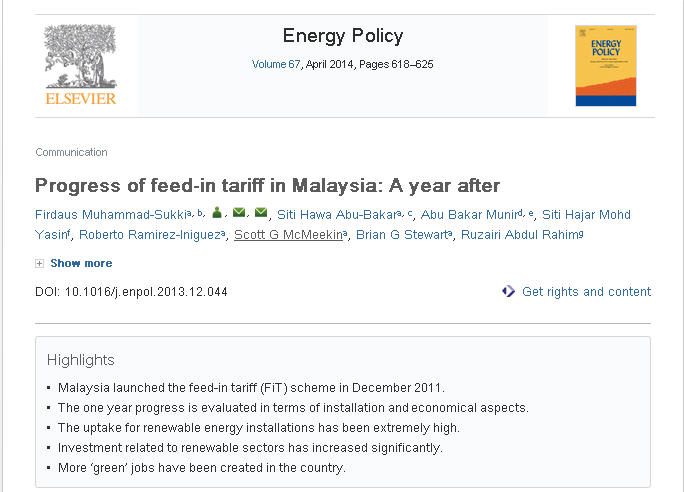
| dc.description.abstract | Malaysia enacted the Renewable Energy Act in April 2011. One of its important components is the feed-in tariff (FiT) scheme—launched in December 2011. The scheme is managed and administered by the Sustainable Energy Development Authority (SEDA) of Malaysia. This paper analyses the impact of the FiT mechanism in Malaysia a year after its implementation; particularly on the installation and economical aspects. First, the history of the scheme is presented before summarising the application process for the scheme. Next, a detailed evaluation on the implication of the scheme is discussed. Some of the key findings from the analysis include: (i) the uptake for renewable energy installations has been extremely high, particularly for solar photovoltaic installation; (ii) the foreign and domestic direct investment related to renewable sectors have increased significantly; (iii) more ‘green’ jobs have been created, particularly in the manufacturing and installation sectors, and (iv) there are plans to include wind and thermal energy in the FiT scheme. It can be concluded that the FiT scheme in Malaysia has produced significant impact during the first year of its implementation. With a proper monitoring by SEDA and more awareness among the people, renewable energy will most likely flourish in Malaysia | en_US |
| dc.publisher | Elsevier | en_US |
| dc.subject | Feed-in tariff | en_US |
| dc.subject | Renewable energy | en_US |
| dc.subject | Solar photovoltaic | en_US |
| dc.title | Progress of feed-in tariff in Malaysia: A year after | en_US |